The AI Data Center Debt Trap: Why the Next Subprime Crisis is Hiding in Off-Balance-Sheet Silicon

Disclaimer: The views, analyses, and perspectives expressed in this article are solely my own personal opinions and do not represent the official stance, strategy, or endorsement of Red Hat or IBM.
1. The Echoes of 2007: When Distressed Debt Wears an AI Badge
In 2007, Wall Street convinced the world that packaging subprime residential mortgages into complex off-balance-sheet structures could magically eliminate default risk. The rating agencies stamped them investment-grade, the syndicate banks collected enormous underwriting fees, and the market treated mortgage-backed securities as virtually risk-free.
Today, history is repeating itself, not with subprime suburban tract houses, but with multi-gigawatt artificial intelligence data centers.
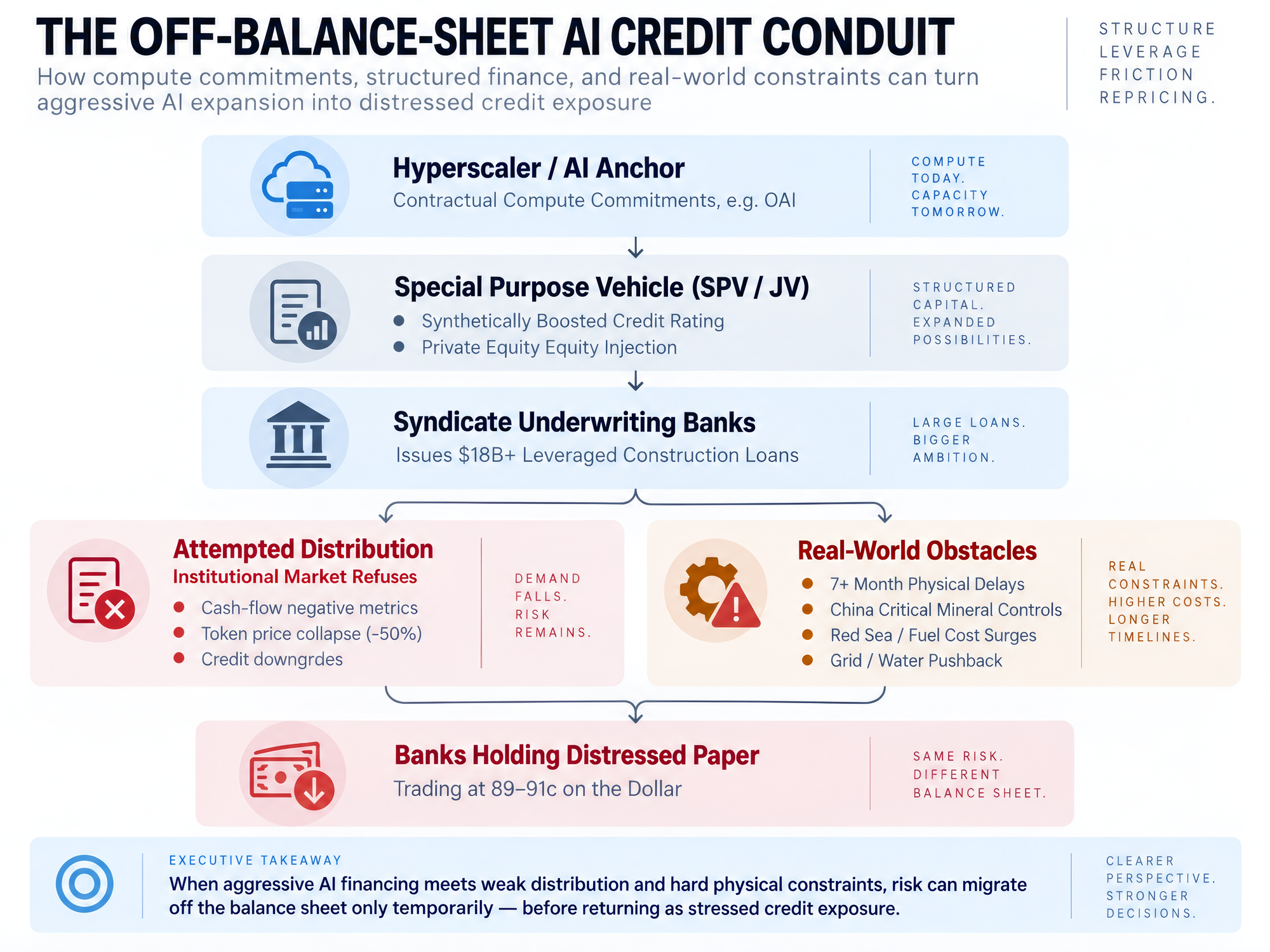
In mid September 2026, macro analysts sounded an alarm that corporate boardrooms and institutional credit desks can no longer ignore: $18 billion in leveraged syndicated loans tied to Oracle’s massive $165 billion "Project Jupiter" data center campus in New Mexico have suddenly tumbled into distressed territory, trading down to 89 to 91 cents on the dollar just months after issuance.
In corporate credit, healthy infrastructure paper trades within fractions of par (100). For syndicated debt of this scale to plunge into the high 80s in a matter of months is virtually unprecedented for a blue-chip tech initiative. Syndicate banks, including Santander and Jefferies, who underwrote the debt with the expectation of quickly flipping it to pension funds, private credit asset managers, and sovereign wealth funds, have hit an iron wall.
Institutional investors are refusing to buy. The debt is stuck on bank balance sheets, marking the opening tremors of what may become the first systemic credit crunch of the generative AI era.
2. Engineering the Illusion: Special Purpose Vehicles (SPVs) and Rating Alchemy
How did an infrastructure project of this magnitude reach distressed levels so rapidly? The answer lies in the financial engineering used to construct it: Special Purpose Vehicles (SPVs).
Oracle’s Project Jupiter was designed to supply computing power for OpenAI’s ambitious $300 billion multi-year compute roadmap. But funding an infrastructure buildout of that magnitude directly from a corporate balance sheet presents an immediate problem: Oracle’s balance sheet was already heavily leveraged, and in July 2026, S&P downgraded Oracle’s credit rating to a single notch above junk.
To bypass bond-market scrutiny and prevent a catastrophic downgrade into speculative-grade status, hyperscalers and private equity sponsors (such as Blue Owl and Blackstone) turned to the classic pre-2008 playbook: off-balance-sheet SPVs.
- The SPV Shell: A distinct corporate entity is created to own the physical real estate, power substations, and server racks.
- Synthetic Credit Enhancement: The SPV signs an irrevocable "take-or-pay" lease or compute capacity agreement with the tech tenant. Rating agencies look through to the contract revenue, granting the SPV debt a synthetic investment-grade rating that the corporate parent could never achieve on its own credit.
- Syndication and Bailout: Syndicate banks issue tens of billions in leveraged construction loans, intending to offload the paper to yield-hungry debt markets.
The structural flaw in this architecture is that debt service depends entirely on a completed, operational asset generating projected cash flows.
In the real world, Project Jupiter is reportedly at least seven months behind schedule, stalled by fierce local resistance over community water depletion and emissions in New Mexico. A half-built data center with empty concrete pads and stranded conduit produces exactly zero dollars in EBITDA.
With Oracle already burning billions in capital expenditure and Morgan Stanley calculating that hyperscalers are sitting on $3.1 trillion in total off-balance-sheet commitments ($1.7 trillion in hardware and purchase obligations alone, up $1.3 trillion in just a single quarter), institutional bond markets have finally realized that these loans are unsecured construction risks masquerading as pristine digital utilities.
3. The Physical Supply Chain Squeeze: Geopolitics, Critical Minerals, and Diesel Inflation
Financial models often assume that data center capacity scales linearly with capital deployment: input $10 billion in debt, receive 100,000 liquid-cooled GPUs twelve months later.
Reality is governed by physics, geography, and geopolitics. The cost and timeline of bringing an AI data center online are being crushed by three compounding exogenous shocks:
3.1 China’s Chokepoint on Critical Minerals
Modern AI hardware is fundamentally reliant on advanced compound semiconductors, high-bandwidth optics, and power distribution systems that cannot function without specialized raw materials.
Over the past 24 months, the Ministry of Commerce of China has systematically weaponized its mineral processing monopoly:
- Gallium and Germanium Controls: Placed under strict dual-use export licensing regimes, with direct bans applied to targeted US entities. Gallium is indispensable for Gallium Nitride (GaN) power stages required to deliver 1,000+ amps directly to modern accelerator dies, while Germanium is the lifeblood of high-speed 800G and 1.6T silicon photonics and optical transceivers linking data center clusters (Center for Strategic and International Studies (CSIS), 2024–2026).
- Antimony and Superhard Materials: Restrictions implemented in late 2024 and maintained through 2026 have restricted supplies of specialized thermal interface materials, industrial cutting diamonds used in wafer planarization, and fire-retardant battery enclosures for megawatt-scale uninterruptible power supplies (UPS).
When raw material export licenses take months to clear Beijing's regulatory apparatus, component fabricators face rolling production pauses. As a result, Tier-1 sub-assemblies (such as step-up transformers, busways, and liquid-to-liquid cooling manifolds) see their lead times balloon from 20 weeks to over 70 weeks.
3.2 The Middle East Maritime Chokepoint
Data center hardware logistics are overwhelmingly globalized. Advanced silicon fabricated in Taiwan is packaged in Southeast Asia, mounted onto PCBs in China and Mexico, integrated with European power electronics, and shipped across intercontinental maritime trade routes.
Escalating security crises in the Middle East, specifically around the Bab el-Mandeb Strait / Red Sea and the recurrent threats surrounding the Strait of Hormuz, have forced major container lines (Maersk, MSC, Hapag-Lloyd) to divert maritime traffic around the Cape of Good Hope (Drewry Maritime Research, 2026).
- Transit Delays: Rerouting around Africa adds 10 to 25 days to transit times each way, disrupting precision "just-in-time" data center installation schedules.
- War-Risk & Freight Surcharges: Shippers face Emergency Conflict Surcharges and escalating maritime insurance, driving up the delivered landed cost of structural components, steel framing, and electrical switchgear.
3.3 Heavy Logistics and the Diesel Tax
It is easy to forget that before an AI data center becomes a digital cloud, it is a massive civil engineering project requiring thousands of tons of concrete, structural steel, cooling towers, and industrial diesel backup generators (gensets).
Every ton of earth moved, every yard of concrete poured, and every Caterpillar/Cummins backup generator delivered to a New Mexico or Virginia site runs on diesel fuel. When geopolitical turbulence in the Middle East drives Brent crude toward $90+ per barrel, diesel crack spreads widen violently.
Transporting a 50-ton step-up transformer or a 3-megawatt backup generator across the country via specialized heavy-haul trucking is not a negligible line item; rising transport fuel and generator commissioning costs create direct cost overruns that blow through the tight contingency budgets established in syndicate debt covenants.
4. The View from the Trenches: How Hardware Costs Are Cannibalizing Enterprise Software
While hyperscalers wage multi-billion-dollar debt campaigns, the impact on enterprise IT departments and mid-market organizations is immediate, tangible, and severe.
As an Enterprise Solutions Architect at Red Hat, I sit on the frontline of enterprise infrastructure conversations daily. In discussions with C-level, enterprise architects, and engineering directors, a distinct and troubling pattern has emerged over the past year: the AI hardware CapEx black hole is cannibalizing enterprise software and platform budgets.
4.1 The Budget Cannibalization Dilemma
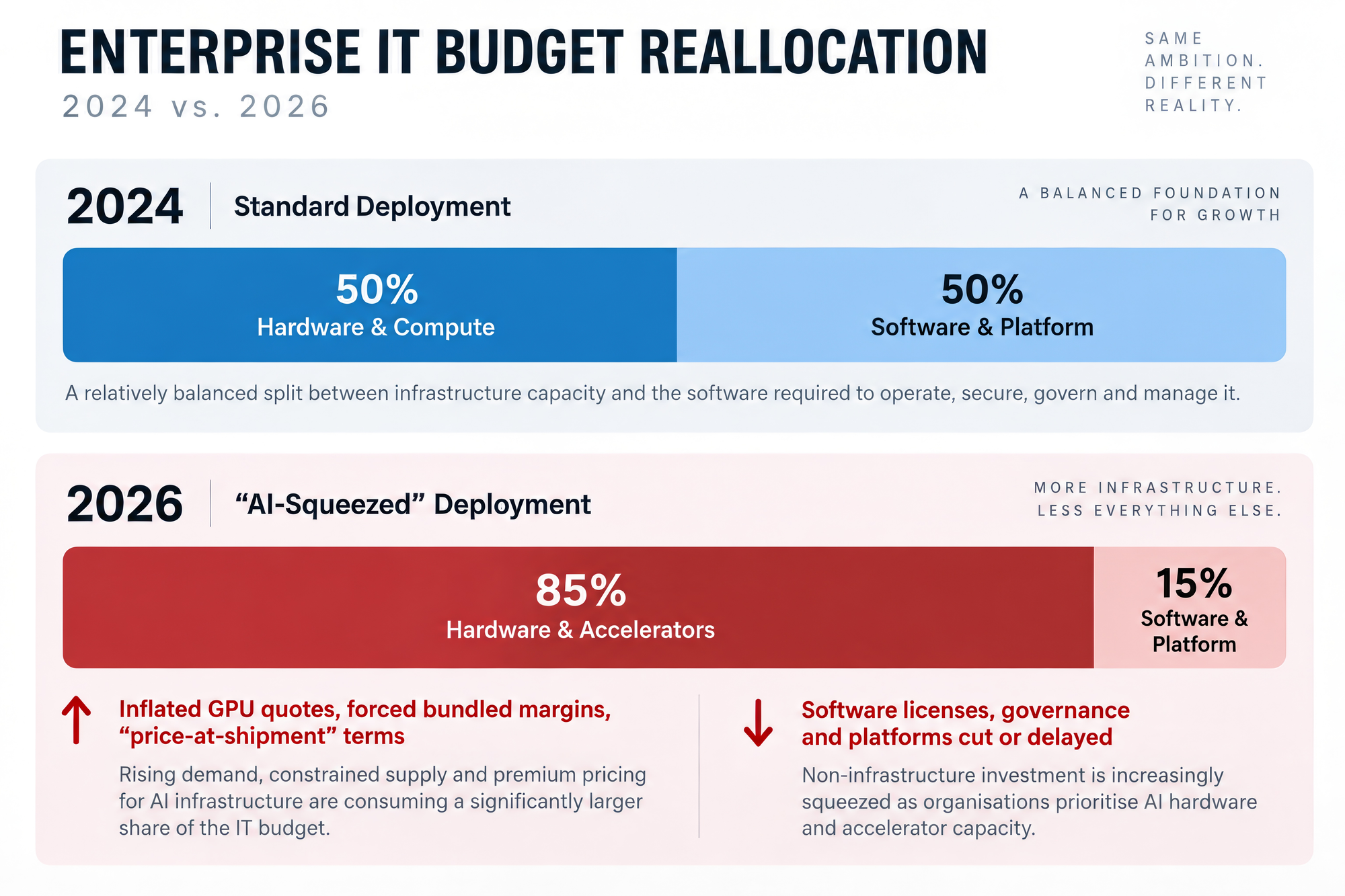
Historically, an enterprise deploying a new compute cluster balanced its budget roughly 50/50 between physical compute/storage/networking hardware and the operational software platform stack (operating systems, container orchestration, cluster management, developer tooling, and enterprise support).
Today, that math has been obliterated:
- A single AI server node loaded with modern accelerators (such as 8x NVIDIA H100/H200 or B200 systems) commands an invoice price ranging from $300,000 to over $450,000.
- Enterprise procurement teams submit an AI project proposal with an all-in budget cap of $1.5 million. When the hardware vendor returns a quote consuming $1.3 million solely for two or three dense compute chassis, the customer is left with a mere $200,000 for the entire rest of the project.
- The Result: Deals stall. Customers are forced to either slash software platform licenses, defer critical security and automation tools, or run advanced production hardware on unsupported upstream software without enterprise life-cycle management or zero-day vulnerability patching. They buy the high-performance engine, but cannot afford the transmission, safety brakes, or steering wheel.
4.2 Allocation Starvation for the Mid-Market
If you are Microsoft, Meta, or Google, hardware OEMs will bend their logistics networks to deliver 50,000 accelerators to your loading dock.
If you are a regional bank, a state healthcare network, a logistics operator, or a mid-tier university needing an order of four to sixteen GPU servers, you are effectively invisible.
Discussions across industry forums and technical communities tell the real story:
- On communities like
r/sysadminandr/datacenter, infrastructure engineers report that standard server quotes now come with validity windows as short as 24 to 48 hours. - OEMs and distributors increasingly insist on "price at time of shipment" clauses. A customer agrees to a capital budget in Q1 based on a $350,000 server quote; by the time the box ships in Q4, the price has inflated by 18%, blowing up the procurement department's fiscal plan.
- Lead times for Tier-2 enterprise accounts routinely stretch to 40 to 52 weeks. Many smaller orders are quietly deprioritized or cancelled outright when a hyperscaler swoops in to absorb an entire production batch.
This creates a dangerous divergence: small and mid-sized enterprises are blocked from deploying local on-premises AI solutions due to lead-time starvation, while simultaneously being priced out of commercial cloud instances due to ballooning hyperscaler hourly rates.
5. The Macro Repercussions: Squeezed Tokens, Debt Inundation, and the Equity Trap
The fundamental economic vulnerability of the AI infrastructure boom is a profound mismatch between capital investment and realized cash flow:
- Token Deflation vs. Hardware Inflation: While the capital cost of building data centers and acquiring hardware has skyrocketed, the market price of compute output measured in dollars (per million inference tokens) has cratered. Open-source model optimization, aggressive price wars between API providers, and architectural efficiencies have driven commercial token prices down by over 50% since their mid-2025 peaks.
- The Free Cash Flow Deficit: Across the entire hyperscaler cohort, virtually every player outside of Microsoft is now operating in free-cash-flow negative territory, heavily weighed down by unprecedented CapEx spending.
- The 2027 Refinancing Wall: Wall Street estimates that hyperscalers will need to issue upwards of $420 billion in new investment-grade debt in 2027 alone just to service ongoing commitments and debt maturities.
- This financing boom is now colliding with an unusually hostile monetary backdrop. The Federal Reserve has raised interest rates by another 25 basis points in an attempt to contain inflation, even as a significant part of the current inflationary impulse originates in the physical economy: energy, commodities, shipping and supply-chain disruption. Higher interest rates cannot produce more barrels of oil, transformers, GPUs or grid capacity; they can only suppress demand and increase the cost of capital. If borrowing costs continue rising while physical input costs remain elevated, policymakers risk weakening investment and economic growth without fully eliminating the underlying supply shock, precisely the conditions from which stagflation can emerge.
- That matters enormously for the AI infrastructure boom. Projects such as Oracle's Project Jupiter require tens of billions of dollars of long-duration financing at exactly the moment credit is becoming more expensive and investors more selective. Meanwhile, the ultimate demand anchor, OpenAI, is already generating extraordinary revenue but remains deeply cash-flow negative as it finances an even larger expansion of compute capacity. The danger is therefore not that AI lacks demand; it is that the cost of financing the physical infrastructure required to satisfy that demand may rise faster than the cash flows ultimately available to support it.
If the institutional credit market continues to reject this paper as evidenced by the 89-cent pricing on Oracle’s Project Jupiter debt; debt issuance will grind to a halt. When debt markets close, hyperscalers face only two remaining options:
- Option A: Slash CapEx. Immediately halt new data center construction, triggering an instant revenue collapse for hardware manufacturers, power equipment suppliers, and construction contractors.
- Option B: Issue Equity. Fund the buildout by dumping hundreds of billions in newly minted equity onto public stock markets. This would dilute existing shareholders, compress earnings-per-share (EPS), and trigger an aggressive repricing across the major technology indices.
6. Strategic Takeaways: The CFO and Enterprise Architect Playbook
How should enterprise leaders, financial officers, and solutions architects navigate an environment where hyperscalers are over-leveraged, hardware supply is fragile, and the credit cycle is tightening?
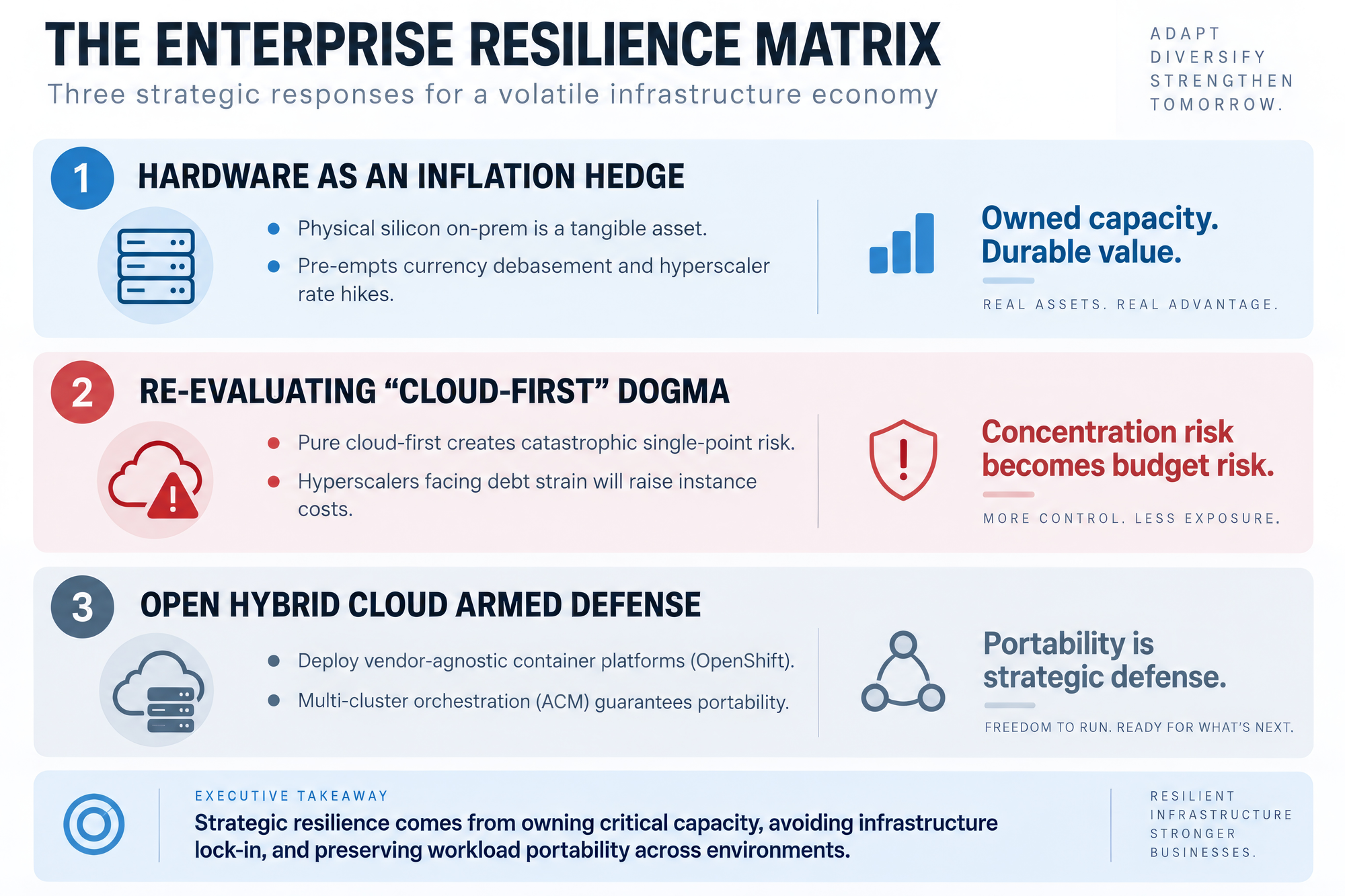
1. Physical Hardware as an Inflation Hedge
When credit crises threaten the broader economy, history demonstrates that central banks and sovereign governments respond with the only tool in their playbook: they print money to liquefy the banking system.
Monetary debasement inevitably drives high structural inflation across physical assets. In this context, securing physical enterprise hardware on reasonable terms today acts as a direct hedge against future inflation. A rack of enterprise servers fully owned, depreciated, and operating inside a private or collocated facility represents real, tangible productive capacity that is immune to cloud subscription price increases, dollar devaluation, and sudden vendor terms-of-service revisions.
2. Re-evaluating the "Cloud-First" Dogma
For a decade, the enterprise consensus has been an uncritical adherence to "cloud-first" migrations. IT executives operated under the assumption that the hyperscalers are permanent, infallible, and will perpetually lower prices due to economies of scale.
That era is over. The distress in Oracle's syndicated debt proves that hyperscalers are financially fragile entities navigating severe balance-sheet stress. When hyperscalers are forced to refinance billions in debt at 7% to 9% interest rates, they will not absorb those costs, they will pass them directly to enterprise customers through higher instance pricing, egress fee increases, and tighter API rate limits.
If your entire corporate operating model is locked inside a single proprietary public cloud, you are a hostage to their debt restructuring.
3. The Open Hybrid Cloud Defense: Red Hat OpenShift & ACM
The only sustainable antidote to hyperscaler credit risk and hardware allocation bottlenecks is architectural workload portability and data sovereignty.
Rather than betting the enterprise on a single public cloud provider or waiting indefinitely for unavailable custom hardware:
- Build Connected Hybrid Clouds: Utilize open, vendor-neutral application foundations like Red Hat OpenShift paired with Red Hat Advanced Cluster Management (ACM).
- Maintain Architectural Freedom and Sovereignty: An open hybrid cloud platform decouples your business logic and AI workloads from the underlying cloud provider’s proprietary APIs.
- Dynamic Workload Shifting: If your primary hyperscaler suffers a regional outage, hikes its GPU instance rates by 30%, or faces financial restructuring, a federated OpenShift architecture allows you to dynamically shift model training, data pipelines, and inference services to a secondary provider, a local colocation partner, or your own on-premises bare-metal servers.
Final Thought
We have spent years treating compute infrastructure as an infinite, ethereal utility that exists invisibly in the ether.
The crisis brewing in the New Mexico desert reminds us that the cloud is made of concrete, copper, diesel, and billions of dollars in high-risk leverage. The organizations that survive the coming shakeout will not be the ones that signed the largest single-cloud purchase commitments, they will be the pragmatic enterprises that built sovereign, hybrid, and resilient architectures capable of running anywhere, on anything, at any time.
Key Sources & Research References
Primary Company & Regulatory Filings
- Oracle Corporation — FY2026 Form 10-K, U.S. Securities and Exchange Commission. Capital expenditure, data-center lease commitments, purchase obligations, power commitments, financing exposure, and OCI infrastructure expansion.
- Meta Platforms — 2026 SEC Filings. Data-center leases, colocation obligations, network infrastructure commitments, and non-cancellable contractual commitments related to AI infrastructure expansion.
- NVIDIA Corporation — 2026 SEC Filings. Long-term supply and capacity commitments, data-center infrastructure, cloud agreements, strategic investments, and guarantees supporting the AI ecosystem.
- OpenAI — “Stargate Advances with 4.5 GW Partnership with Oracle.” Primary disclosure regarding the scale and capacity requirements of the Stargate infrastructure programme.
- OpenAI — “OpenAI, Oracle, and SoftBank Expand Stargate with Five New AI Data Center Sites.” Primary disclosure regarding the Oracle/OpenAI partnership exceeding $300 billion over five years.
- Oracle — Project Jupiter Power and Water Disclosures. Corporate disclosures concerning the redesign of Project Jupiter's power architecture, water consumption, environmental permitting, and local infrastructure commitments.
Credit Markets & AI Infrastructure Financing
- Reuters — “Oracle's $18 Billion Data Center Debt Under Pressure.” September 2026. Reporting on Project Jupiter loan pricing, syndication difficulties, Oracle's credit downgrade, bank exposure, permitting challenges, and local opposition.
- Financial Times — “Oracle's $18bn Data Centre Debt Under Strain Amid Local Pushback.” September 2026. Reporting on Project Jupiter's financing structure, stressed loan pricing, project delays, credit-market concerns, and investor distribution challenges.
- Financial Times — “Big Tech Uses Guarantees to Keep $300bn of AI Exposure Off Balance Sheets.” September 2026. Analysis of special-purpose vehicles, residual-value guarantees and structured financing used by major AI infrastructure participants.
- Morgan Stanley Research — “Shifts in Credit Markets for the AI Buildout.” August 2026. Analysis of the rapidly evolving debt, project-finance and private-capital structures supporting global AI infrastructure investment.
- Morgan Stanley — Hyperscaler Off-Balance-Sheet Commitment Analysis. August 2026. Estimates of more than $3.1 trillion in leases, purchase commitments, guarantees and other financial support associated with hyperscalers and semiconductor companies.
- Reuters — “Corporate Bond Buyers Get Picky with Flood of AI Debt.” September 2026. Analysis of hyperscaler borrowing, widening AI-sector credit spreads, changing investor appetite and projected 2027 investment-grade issuance.
- S&P Global Ratings / Financial Press Coverage — Oracle Credit Rating Downgrade. July 2026. Analysis of Oracle's downgrade to BBB- and the effect of large-scale AI infrastructure commitments on its credit profile.
Power, Physical Infrastructure & Supply Chains
- International Energy Agency — “Energy and AI.” Analysis of global data-center electricity consumption, AI-driven capacity growth, electricity supply requirements and infrastructure constraints.
- International Energy Agency — “Key Questions on Energy and AI.” Analysis of AI infrastructure financing requirements, power bottlenecks and the increasing dependence of data-center expansion on capital-market conditions.
- U.S. Department of Energy / Lawrence Berkeley National Laboratory — “U.S. Data Center Energy Use.” Analysis of rapidly rising electricity demand from U.S. data centers and AI workloads.
- Reuters — “U.S. Power Companies Scramble to Secure Equipment as Surging Data Center Demand Strains Supplies.” July 2026. Reporting on transformer, switchgear and grid-equipment shortages, extended lead times and rising infrastructure costs.
- Reuters — “Niche Metals Test West's Resilience to Chinese Export Curbs.” September 2026. Analysis of gallium and germanium supply concentration, Chinese export controls and continuing semiconductor supply-chain exposure.
- Drewry Maritime Research. Research on Red Sea disruption, Cape of Good Hope rerouting, global container capacity and freight-market economics.
- Reuters — Global Shipping and Red Sea / Cape of Good Hope Disruption Coverage. 2026. Reporting on extended transit times, higher fuel requirements, shipping surcharges and growing pressure on international supply chains.
- Searchlight New Mexico — Project Jupiter Permitting and Construction Coverage. September 2026. Independent local reporting on construction progress, environmental permitting disputes, water concerns and judicial intervention.
AI Economics & Inference Pricing
- OECD — “Artificial Intelligence Markets.” 2026. Analysis of rapidly declining quality-adjusted AI inference prices, competition between model providers and the economics of increasingly token-intensive agentic workloads.
- Stanford Institute for Human-Centered Artificial Intelligence — “AI Index Report 2025.” Analysis of long-term declines in inference cost for comparable levels of AI model capability.
- Reuters — OpenAI Developer Pricing Coverage. 2026. Reporting on substantial reductions in API pricing amid increasing competition between U.S., European and Chinese model providers.
Supplementary Commentary & Field Evidence
- Steven Van Metre Financial Research. September 2026. Commentary and analysis concerning Project Jupiter syndicated loan pricing, banking exposure and potential implications for the broader AI credit cycle.
- Industry practitioner discussions and technical communities, including r/sysadmin and r/datacenter. Supplementary anecdotal evidence concerning enterprise hardware availability, procurement lead times, quote validity, allocation pressure and pricing volatility.